



It's 2:30 AM, and you wake up because your tongue is stuck to the roof of your mouth. You take a drink, roll over, and at 7:00 AM, it happens again. If you search for this, you get the same list everywhere: dehydration, medication, mouth breathing, air that's too dry. That list is accurate. But nobody tells you how to figure out which cause applies to you. That is exactly what this article does. Using four morning profiles, you will determine where your dry mouth comes from and what logically fits that situation.
Why your mouth gets drier at night anyway
Your saliva production decreases at night. This is normal: you aren't eating or drinking, so your body produces less saliva. For most people, you don't notice this at all.
A dry mouth occurs when there is too little saliva to keep the mouth moist. The medical term is xerostomia. At night, saliva production naturally drops, which is why symptoms are more noticeable then than during the day. Saliva protects against tooth decay, supports swallowing, and keeps the oral mucosa intact.
The latter explains why a persistently dry mouth is more than just an inconvenience. With long-term symptoms, the risk of cavities and gum inflammation increases, and your breath may become less fresh. Reliable information about saliva and the role of medication can be found at Apotheek.nl, whose condition information is written by the Dutch College of General Practitioners.
Which morning profile suits you?
A dry mouth on its own says little, because almost every cause results in the same sensation. The clue lies in what else you notice at the moment you wake up.
That is why we use four morning profiles in this article. Each profile consists of a combination of signals that point to a different cause, and therefore a different approach.
Check the table to see which row best matches your morning.
|
What you notice in the morning |
Profile |
Probable cause |
|
Dry mouth, dry throat, sometimes a drool spot on your pillow |
1 |
Mouth breathing |
|
Dry mouth and a nose that is blocked at night |
2 |
Nasal congestion forces you to mouth breathe |
|
Dry mouth, but you do breathe through your nose |
3 |
Medication, fluids, or room air that is too dry |
|
Dry mouth, loud snoring, and tired during the day |
4 |
Possible breathing stops during sleep |
If you recognize multiple profiles, start with the lowest one. Profile 4 always takes precedence: this first requires a conversation with your GP.
Profile 1 - Dry mouth with a drool spot on your pillow
This is the most common combination. You breathe through your mouth at night, causing your mucosa to dry out due to the hours-long airflow. Your nose humidifies and warms the air; your mouth does not.
The drool spot seems contradictory for a dry mouth, but it actually fits. With an open mouth, saliva runs out instead of staying in your mouth. You can read more about that mechanism in why people sleep with their mouths open.
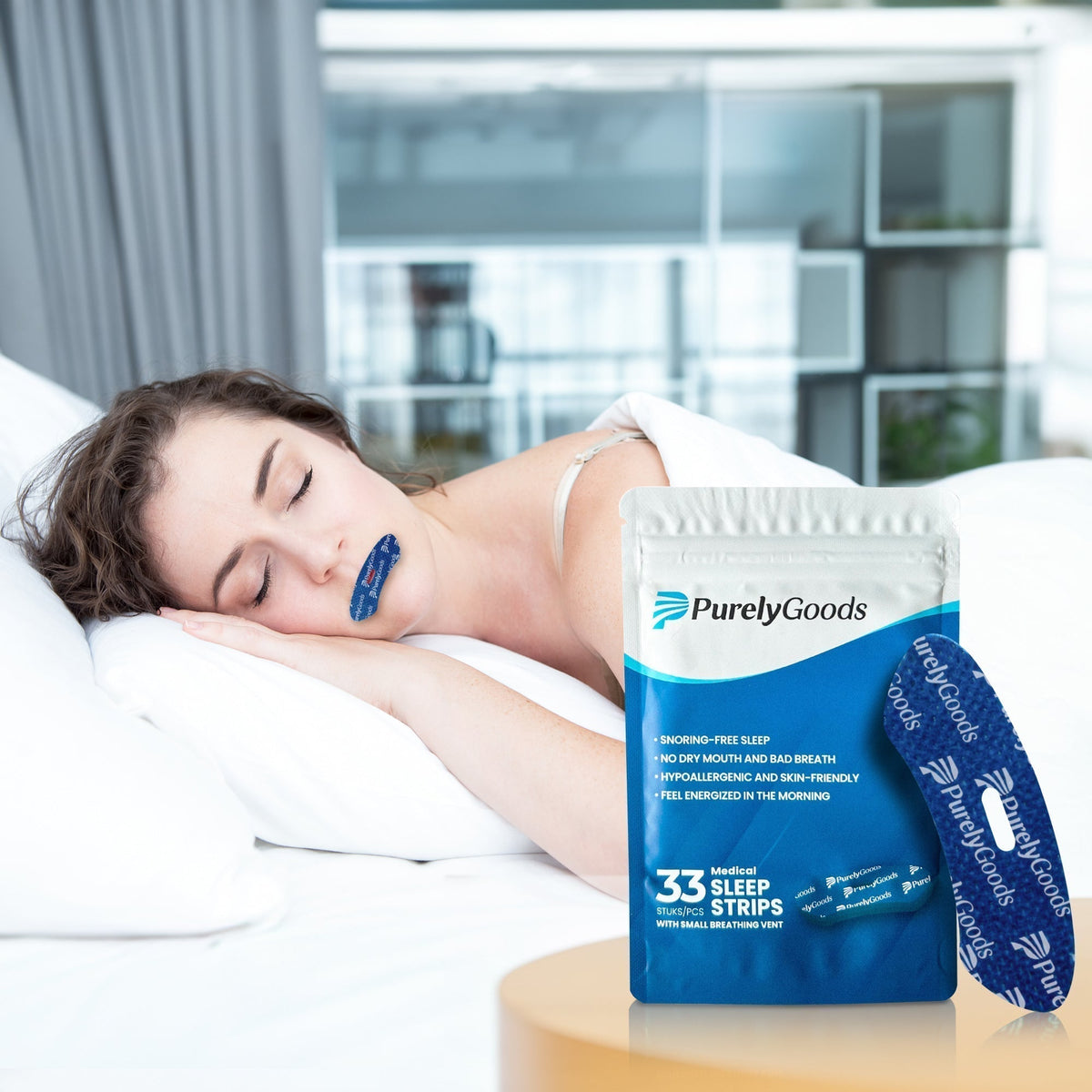
What fits this. First, check if your nose is clear. If it is, your mouth falls open mainly due to habit or muscle relaxation. Mouth tape keeps your lips gently closed, stimulating nasal breathing. Build it up slowly: start with an hour on the couch in the evening, not an entire night right away. You can read about how it works in what mouth tape is and how it works.
Profile 2 - Dry mouth with a nose that is blocked
If your nose is blocked at night, your body automatically switches to your mouth. You may want to close your mouth, but you can't get any air.
The cause of that congestion determines the approach. Colds and hay fever are temporary. A deviated nasal septum or chronic swollen nasal mucosa is not. Also, the nose works differently when lying down compared to standing: your nasal mucosa swells slightly as soon as you lie down.
What fits this. If your nostrils collapse when breathing in, nasal strips hold the nasal entrance open from the outside. If the congestion is deeper, for example due to mucosal swelling, nasal strips do little. In that case, consult your GP.
Important: do not use mouth tape as long as your nose is truly blocked. You would be closing off the only route that is working at that moment.
Profile 3 - Dry mouth while breathing through your nose
If your mouth isn't involved in your breathing at night, the most common explanation is ruled out. You are then dealing with something that lowers your saliva production itself, or conditions that dry out your mucosa without your breathing being to blame.
Three candidates are the first to consider:
- Medication. A dry mouth is a listed side effect of antidepressants, blood pressure reducers, antihistamines, and diuretics, among others. If you take them in the evening, the effect is most noticeable at night.
- Too little fluid during the day. Don't drink extra right before sleep, but throughout the day. Drinking a lot right before bedtime mainly results in trips to the bathroom.
- Room air that is too dry. In winter with the heating on, humidity drops significantly. A lower bedroom temperature and airing the room briefly help.
Additionally, alcohol, smoking, and caffeine play a role, and conditions such as diabetes or Sjögren's syndrome can cause a dry mouth.
What fits this. Start with the factors you can influence: fluids throughout the day, room air, and the timing of your alcohol or coffee. If you suspect medication, discuss this with your GP or pharmacist and never stop taking a medication on your own. A sleep aid adds nothing in this profile; it's more honest to admit that.
Profile 4 - Dry mouth with snoring and daytime fatigue
Do you snore loudly, wake up with a dry mouth, and feel tired during the day despite enough hours in bed? Then there is more going on than just a dry mouth.
For some snorers, the airway narrows so severely during sleep that breathing stops briefly. The mouth often opens during this process. Your sleep becomes fragmented without you remembering it. Daytime fatigue is then the clearest signal.
What fits this. This profile first requires an assessment by your GP, not a product. Do not use mouth tape here before breathing stops have been ruled out. If you want to know which anti-snoring devices fit which cause in the meantime, check our anti-snoring device comparator.

Dry mouth and bad breath in the morning
Many people search for these two complaints separately, as if they were two different problems. In practice, morning breath and a dry mouth rarely occur independently of each other, and that is no coincidence.
The explanation lies in the saliva that connects both complaints.
Saliva flushes away food particles and keeps the bacteria in your mouth in balance. If saliva production drops significantly at night, bacteria that produce sulfur compounds have more room. Those compounds are responsible for the typical morning smell.
If you also breathe through your mouth, your mucosa dries out further and strengthens the effect. That explains why mouth breathers report bad morning breath more often than nose breathers, even with the same oral hygiene.
What helps with this:
- Brush thoroughly in the evening and also clean between your teeth.
- Clean your tongue with a tongue scraper or toothbrush.
- Restore your nasal breathing as much as possible so that your mucosa remains moist.
- Discuss persistent symptoms with your dental hygienist.
Bad morning breath that disappears quickly after brushing is normal. If the odor remains present all day, that is a matter for your dentist or GP, not a sleep aid.
What you can do tonight
Regardless of your profile, there are measures that soothe the discomfort without masking the cause:
- Keep water next to your bed, but take small sips instead of half a glass.
- Limit alcohol and caffeine in the 3 hours before bedtime.
- Keep your bedroom around 16 to 19 degrees Celsius and air it briefly before sleeping.
- Brush thoroughly in the evening, as a dry mouth increases the risk of cavities.
- Breathe consciously through your nose during the day, so it becomes more natural at night.
Many people underestimate that last habit. Those who habitually breathe through the mouth during the day usually do so at night as well. Read about this in why you should breathe through your nose while sleeping.
How to test which profile is correct in one week
Do you recognize yourself in multiple profiles, or are you doubting between two causes? Then measuring is faster than experimenting. Anyone who buys an aid immediately without knowing which profile applies won't know afterward if it worked or if the night was just better by chance.
You don't have to do anything complicated for this. One week of noting things down usually yields enough information.
Keep your phone or a notepad next to your bed and write down three things every morning, before you drink anything:
- How dry your mouth felt, on a scale of 1 to 5.
- Whether your pillow had a wet spot.
- Whether your nose was clear or congested upon waking.
Add one line in the evening: whether you drank alcohol, and what time you took your medication.
After seven days, look at the combinations. A wet spot plus a clear nose points to profile 1. A congested nose on the driest mornings points to profile 2. A dry mouth without a wet spot and with a clear nose points to profile 3, and then the rule about medication and alcohol often says enough.
If you don't see a pattern at all, or if it varies each night without explanation, take your notes with you to your GP. That is more useful information than "I have a dry mouth at night."
Summarized by profile
Waking up with a dry mouth rarely has one universal solution, because the causes vary. The fastest route to the right approach is through your morning signals. A drool spot points to mouth breathing, a blocked nose to nasal congestion, and a dry mouth without mouth breathing points toward medication, hydration, or room air. Snoring combined with daytime fatigue does not belong in any self-help plan, but rather with your GP. Therefore, determine your profile first, and only then choose a measure.
Not sure which profile fits you? The sleep test will help you on your way, and in the knowledge center you will find background information for each topic.
Deel:
Silk vs. cotton sleep masks: which is better for skin and sleep?
My partner snores: what can I do?