





In the first few days after a long flight, your body is completely out of sync. At 3:00 PM you are almost falling over from exhaustion, at 3:00 AM you are wide awake, and your stomach has a mind of its own. Good news: overcoming jet lag faster is largely a matter of managing light, sleep, and meals intelligently. And the approach differs depending on the direction of your travel.
In this article, you will read why flying to Asia feels different than flying to America, and you will receive a concrete recovery plan for the first few days for both directions. If you want to reduce your jet lag before you even depart, read how to prevent jet lag first; this article is about what to do once you have arrived.
What exactly is jet lag?
Jet lag is the collision between your internal biological clock and the local time at your destination, caused by traveling through time zones faster than your body can adjust. Your sleep, hunger, temperature, and energy still follow the rhythm of home, while the world around you is already hours ahead or behind.
That internal clock, your circadian rhythm, resets itself every day based on light. Without help, it shifts by about one time zone per day. If you fly eight zones away, you will easily be out of sync for a large part of your trip without a plan. With a plan, you can significantly speed up that recovery. You can read exactly how that rhythm works on our page about sleep science.
Why is Asia harder than America?
Here is the big difference that most jet lag advice skips: the direction.
Flying east (Asia) means you are traveling towards the time. You have to sleep earlier and wake up earlier than your body wants to. Advancing your internal clock is more difficult for almost everyone than delaying it; you are asking yourself to fall asleep at a time when your body is still wide awake.
Flying west (America) means you are traveling with the time. Your day gets longer and you are allowed to go to bed later. That aligns with the natural tendency of your clock, which already runs slightly longer than 24 hours on its own. That is why the first days in New York usually feel milder than the first days in Tokyo.
A common rule of thumb: you recover roughly one and a half time zones per day going west, and about one going east. So, for a trip to Asia, count on more recovery days than for the same distance to America.
Recovery plan after a flight to Asia (eastward)
Going east, everything is about advancing. Light is your tool, but pay attention to the timing: incorrectly timed morning light can push your clock in the wrong direction.
- First morning: take it easy with bright light. If you wake up extremely early, stay inside or wear sunglasses in the early morning. Actively seek out daylight starting in the late morning.
- Stay up until a normal local bedtime. No matter how hard it is, don't go to sleep at 7:00 PM. Make it to 10:00 PM–11:00 PM local time, even if you need a walk to do so.
- Limit naps to 20–30 minutes, before 3:00 PM. A power nap takes the edge off the fatigue without ruining your night. Set an alarm; sleeping through is the pitfall here.
- Eat at local times and drink plenty of water. Your stomach has its own clock; breakfast, lunch, and dinner at local times help your entire system shift along. And keep drinking: the dry airplane air dehydrates you, and dehydration worsens jet lag symptoms like headaches and lethargy.
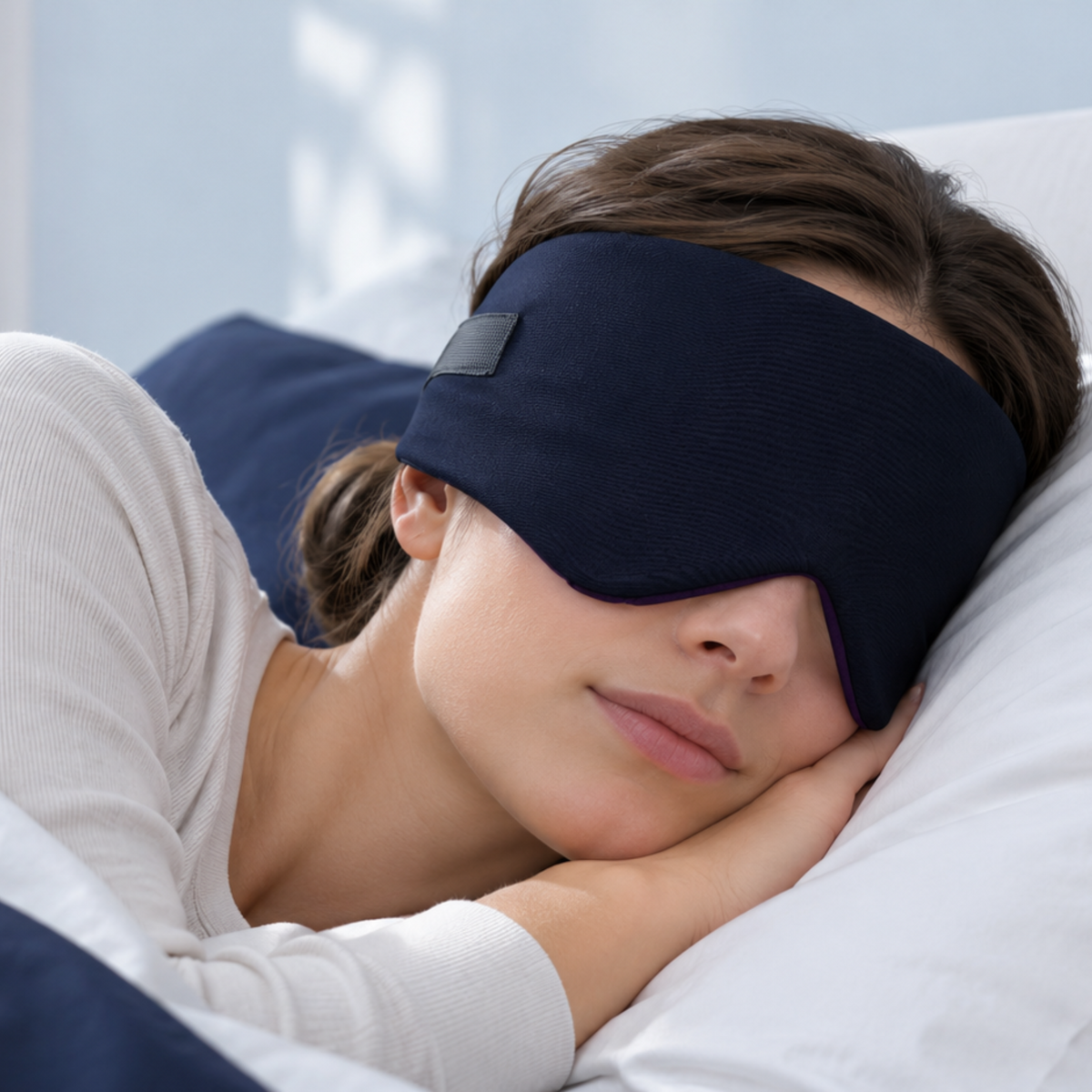
- Protect your nights. If you wake up at 4:00 AM, stay in the dark and use a breathing exercise to drift back off; screen light at that time will set your clock back to the wrong setting again. A sleep mask and earplugs keep out early morning sounds and light; check out our sleep masks for that as well.
Recovery plan after a flight to America (westward)
Going west, you want to stretch your day. That is easier, but has one notorious pitfall: waking up at night around 3:00 AM–4:00 AM because it is morning back home.
- Actively seek out light in the afternoon and early evening. Evening light delays your clock, which is exactly what you want when traveling west. Stay outside, go for a walk after dinner.
- Stretch your evening. Don't go to bed until a normal local bedtime, even if you feel heavy at 8:00 PM. Staying active works better than hanging out on the couch.
- If you wake up at 4:00 AM: stay in the dark. This is the very moment when westward jet lags fail. (Do you often wake up around this time at home as well? That usually has other causes; read why you wake up between 3 and 4 o'clock at night.) No phone, no lights on. While lying down, do a quiet exercise such as the extended exhale from our breathing exercises to relax within 5 minutes, and give yourself the chance to catch another sleep cycle.
- Caffeine only in the morning. A coffee upon early waking is fine; not after lunch, otherwise your falling asleep will be delayed even further. You can read why this is so sensitive in alcohol, caffeine, and sleep.
- Keep the first dinner light and skip the wine. Alcohol seems to help against waking up early, but actually fragments the second half of the night, exactly the part you need.
Example: what your first three days look like
Theory is nice, but you beat jet lag with concrete days. Two examples, assuming arrival in the morning or afternoon.
Arrival in Bangkok (eastward, +6 hours), 07:00 local time:
- Day 1: sunglasses on during the early morning, check in, light walk in the late morning sun. Power nap of a maximum of 25 minutes around 1:00 PM. Active outdoors in the afternoon, dinner at local time, to bed at 10:00 PM with a sleep mask and earplugs.
- Day 2: waking up around 5:00 AM is normal; stay lying in the dark until a reasonable time. Breakfast at local time, plenty of daylight from the late morning onwards, no nap after 3:00 PM.
- Day 3: your rhythm is largely in place; stick to local meal and bed times and taper off the last early awakenings with a breathing exercise in the dark.
Arrival in New York (westward, −6 hours), 14:00 local time:
- Day 1: no naps, no matter how hard it is. Stay outside in the afternoon light, eat a light dinner without alcohol, and stretch your evening to at least 10:00 PM local time.
- Day 2: if you wake up at 4:00 AM, stay in the dark and breathe calmly; only get up at an acceptable time. Morning coffee is fine, not after lunch. Seek out evening light.
- Day 3: the early awakenings are becoming shorter; those who kept the nights dark and quiet are now almost on local rhythm.
See these schedules as a template: shift the times according to your arrival, but keep the principles (light, no long naps, local meals, protected nights) intact.
And what about melatonin?
Melatonin is often mentioned as a jet lag remedy, and it can help shift your rhythm, especially for eastward travel. But it is not candy: the right timing and dosage are sensitive, and incorrect use will shift your clock in the wrong direction. Therefore, do not use it on your own alongside other remedies or medication; consult your pharmacist or doctor first. Without melatonin, you can also get a long way with light, sleep timing, and meals.
"Just sleep in late, then the jet lag is gone," is that true?
No, and this myth actually prolongs many jet lags. Sleeping in until 11:00 AM feels wonderful, but keeps your internal clock exactly on the old rhythm: you will be tired at the wrong time again the next night. Your clock does not reset through more sleep, but through sleep, light, and meals at the right local moments.
The same goes for "pulling an all-nighter to reset yourself." Extreme sleep deprivation does not make your clock faster, but instead stacks sleep debt on top of the jet lag. Consistent small steps win over big shocks.
Who needs extra customization?
- Short trips (2-3 days): consider trying to live as much as possible on your home rhythm, especially for business trips to America. Adapting fully costs more than it yields if you are flying back quickly anyway.
- The elderly often notice jet lag more strongly and recover more slowly; plan for more generous recovery days.
- Families with children: children's clocks shift erratically. Maintain fixed rituals (same stuffed animal, same order) and accept a few messy nights.
- Those who already sleep poorly: a jet lag is layered on top of your existing sleep problem. In that case, also read why you sleep poorly on vacation for the environmental and behavioral side.
Conclusion
Overcoming jet lag revolves around one principle: live on local time as quickly as possible, and guide your clock with light at the right moments. Going eastward (Asia), you curb the early morning light and shift step by step; going westward (America), you stretch your evening and especially protect your second half of the night. Short naps are allowed, sleeping in is not, and alcohol and late caffeine delay your recovery. Give your body about one day per time zone and you will get through it faster than without a plan.
Want to start your approach while still on the go? Every two hours of sleep on board reduces your setback. And make your nights away easier with a blackout sleep mask and good earplugs; you can find them among our travel accessories.
Where did jet lag hit you the hardest: on the outbound journey or upon returning home?


Deel:
How to learn to breathe better during the day (and why it’s important)
How to sleep better on a plane (using breathing techniques)