



Do you notice that your breath is high in your chest when you're stressed? That's no coincidence. Breathing and stress are directly linked, in both directions. Stress changes your breathing, and your breathing can reduce stress. The latter is good news. Your breathing is the only part of your stress system that you can consciously control. In this article, you'll learn how that works and which three techniques have an immediate effect in moments of tension.
What does stress do to your breathing?
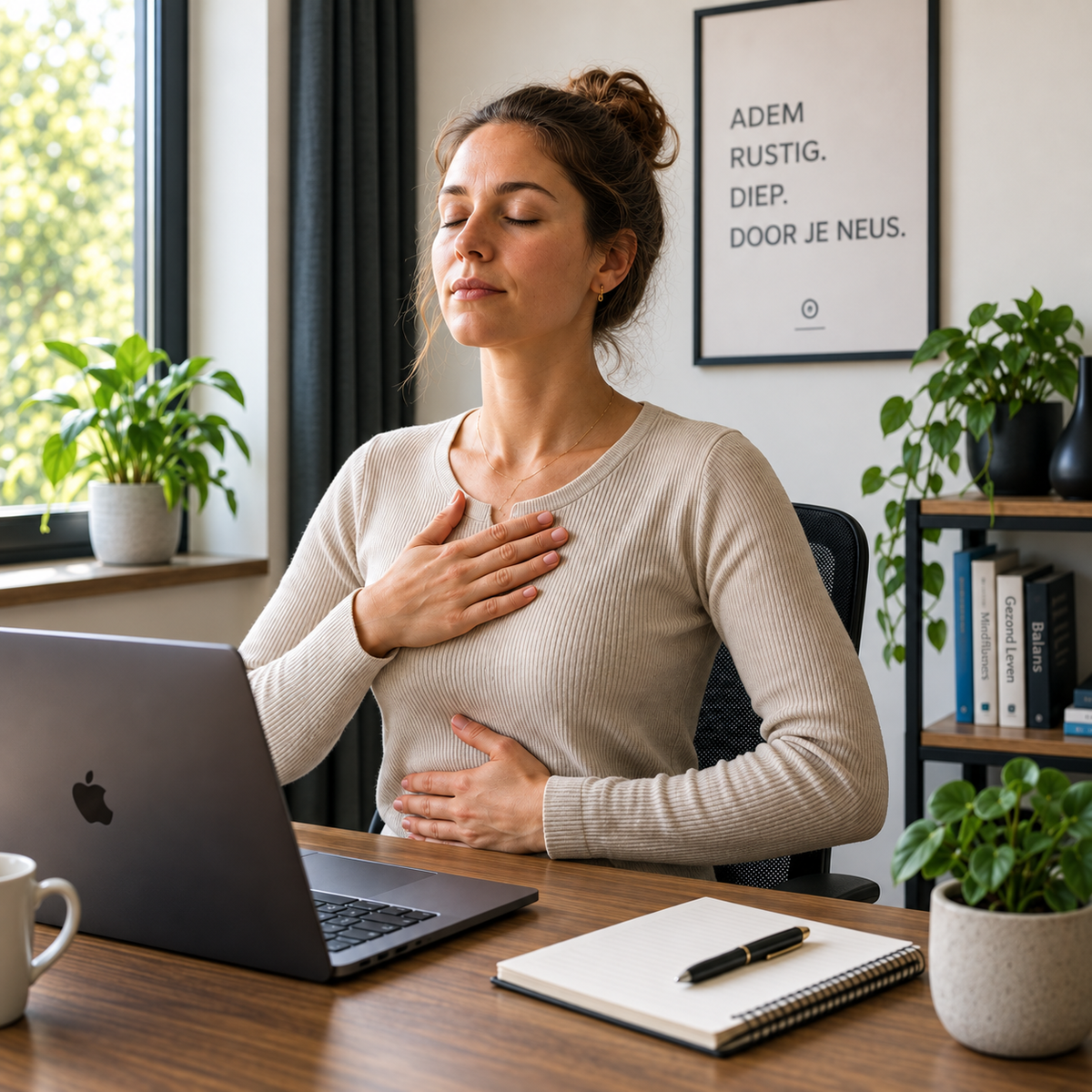
Under stress, your body switches to action mode. Your heart rate increases, your muscles tense, and your breathing becomes faster and shallower. You breathe higher, from your chest instead of your belly.
This reaction is useful in real danger. But most stress nowadays comes from emails, deadlines, and full schedules. Your body prepares to run, while you sit still. The rapid breathing persists and maintains the tension.
This creates a cycle: stress speeds up your breath, and a fast breath tells your brain there is stress. For some people, this can lead to hyperventilation: breathing too fast and too much, resulting in dizziness or tingling.
Why is breathing so directly effective against stress?
Your nervous system has an accelerator and a brake. The accelerator (sympathetic nervous system) activates you during tension. The brake (parasympathetic nervous system) brings you back to rest.
Your exhale controls that brake. With each calm, long exhale, your heart rate drops a little. If you breathe slowly, you send a signal to your brain: it's safe, you can relax.
Research from Leiden University shows that the pace is particularly important: slow and deep breathing, about six breaths per minute, activates the rest system most strongly (Leiden University, 2023). That's about ten seconds per full breath.
Three techniques with immediate effect
These three techniques were chosen based on one criterion: you can use them in the middle of a stressful moment, without anyone noticing.
1. The physiological sigh
This is the fastest reset your body knows. You sometimes do it unconsciously, after crying or when relieved. Here's how to do it: inhale through your nose, and on top of that inhalation, take a short, second gulp of air. Then exhale slowly and for a long time through your mouth. Repeat this one to three times. The double inhalation opens collapsed alveoli, allowing you to release extra tension at once. Ideal just before a difficult conversation or presentation.
2. The prolonged exhale
Make your exhale longer than your inhale. For example: four counts in through your nose, six to eight counts out. It doesn't have to be more. Because exhalation stimulates your rest system, this ratio shifts the balance towards relaxation. Do this for two to three minutes and you'll notice your shoulders dropping. Works discreetly, so also on the train or during a meeting.
3. Box breathing
With box breathing, you breathe in four equal steps: four counts in, four counts hold, four counts out, four counts rest. Imagine a square and follow its sides with your breath. The counting gives your brain something neutral to focus on. This makes this technique especially effective for anxious thoughts: your attention cannot count and ruminate at the same time.

Practice in calm moments, not just when stressed
This is often where it goes wrong. Those who try a breathing technique for the first time in the middle of a stressful moment may feel that it "doesn't work." Some people even become more stressed from forced deep breathing. The Leiden researchers observed the same with students who tried belly breathing for the first time: awkward practice actually caused stress. The solution is simple. Practice the technique a few times a day during calm moments, for example, two minutes after waking up or before eating. This way, the technique becomes automatic. When stress strikes, you no longer have to think; your body already knows the way. If you want concrete short exercises for this, in our article on breathing exercises to relax in 5 minutes, we outline five step by step.
Breathe through your nose, even during the day
All three techniques start with inhaling through your nose. That's not a detail. Nasal breathing naturally slows your breathing rate, filters the air, and supports a calmer breathing pattern than mouth breathing. Many people unconsciously breathe through their mouth when stressed, both during the day and at night. If you notice waking up with a dry mouth in the morning, your body is likely breathing through your mouth at night too. On our page about breathing science, you can read why nasal breathing is the foundation of a calm nervous system.
Stress and sleep also reinforce each other: those who go to bed stressed sleep lighter, and those who sleep poorly are more susceptible to stress during the day. You can read exactly how this interplay works in the connection between sleep and stress.
What breathing doesn't solve
Honesty is important: breathing techniques reduce tension in your body, but they don't remove the cause of stress. An overly full schedule remains an overly full schedule. View breathing as first aid and daily maintenance, in addition to addressing the source. Two situations require more than self-help. Do you regularly suffer from hyperventilation, panic attacks, or shortness of breath? Then consult your doctor before starting intensive breathwork. And if stress persists for weeks, with poor sleep, irritability, or gloom? Even then, your doctor is the right first step. For guided deepening, a breath coach can also be valuable.
Frequently asked questions about breathing and stress
How quickly does a breathing exercise work against stress?
Faster than most people think. A physiological sigh often provides noticeable relief within one minute. For a deeper effect, such as lowered shoulders and a calmer mind, allow two to five minutes of calm breathing. The more often you have practiced a technique, the faster your body responds.
How often should I do breathing exercises?
Short and often wins over long and seldom. Two to three two-minute sessions per day are more effective than one half-hour session per week. Link it to a fixed time, such as after waking up or before lunch, so it becomes a habit.
Can breathing against stress also be counterproductive?
Yes, in two cases. Those who forcefully breathe too deeply or too quickly can become dizzy or even more restless; calm and low is always the starting point. And those who suffer from hyperventilation or panic attacks may experience symptoms from intensive breathwork. In that case, consult your doctor first and then build up gradually.
Does breathing also work against stress at night?
Indirectly, yes. A short breathing exercise before bed lowers your tension level, making it easier to fall asleep. If you wake up at night with a racing mind, the prolonged exhale helps you settle back down. If stress consistently disrupts your nights, also read the connection between sleep and stress.
Summary
Stress and breathing influence each other, making your breath your quickest gateway to calm. The physiological sigh, prolonged exhalation, and box breathing work immediately because they activate your rest system through exhalation. The key is to practice during calm moments, so the technique is ready when you need it. And remember: breathing techniques dampen stress, but addressing the cause remains just as important.
Start small today: choose one technique and do it for two minutes every day this week during a calm moment. Curious how your breathing also affects your nights? Then delve into our breathing science.
Which of the three techniques will you try this week?

Deel:
Snoring while traveling, how do you prevent it?
Breathing exercises to relax in 5 minutes