



You train hard, eat well, and get your hours of sleep, yet that heavy leg fatigue persists. There is a good chance you are overlooking one recovery switch: your breathing. Nasal breathing accelerates your sports recovery, not as a vague wellness idea, but via a concrete mechanism: switching your nervous system from effort to recovery.
In this article, you will read how that works and receive an approach for three moments: immediately after your workout, the hours that follow, and the night. If you are interested in breathing *during* exercise, please read our articles on breathing for strength training and nose or mouth breathing during athletic performance; this piece begins where your training ends.
What is sports recovery, actually?
Sports recovery is everything your body does to return to balance and become stronger after exertion: normalizing heart rate and breathing, repairing muscle damage, replenishing energy stores, and calming the nervous system. Muscles do not grow during the workout, but in the hours and nights that follow.
The often-forgotten prerequisite: recovery only truly begins once your nervous system switches from the effort mode (sympathetic) to the recovery mode (parasympathetic). If your system remains "on" for hours after training, your recovery starts with a delay. And you operate that exact switch with your breathing.
Why your breathing is the recovery switch
During intense exercise, you breathe fast, heavily, and often through your mouth. This is logical and functional: your muscles demand oxygen. But that breathing pattern is also a signal to your body that the exertion is still ongoing.
If you consciously reverse that pattern—making it slow, deep, and through your nose—you reverse the signal. Your long, calm exhalations activate the rest system: your heart rate drops faster, your muscle tension decreases, and your body can get to work repairing instead of performing. The faster your heart rate drops after exertion, the better your recovery position; calm nasal breathing actively assists this drop.
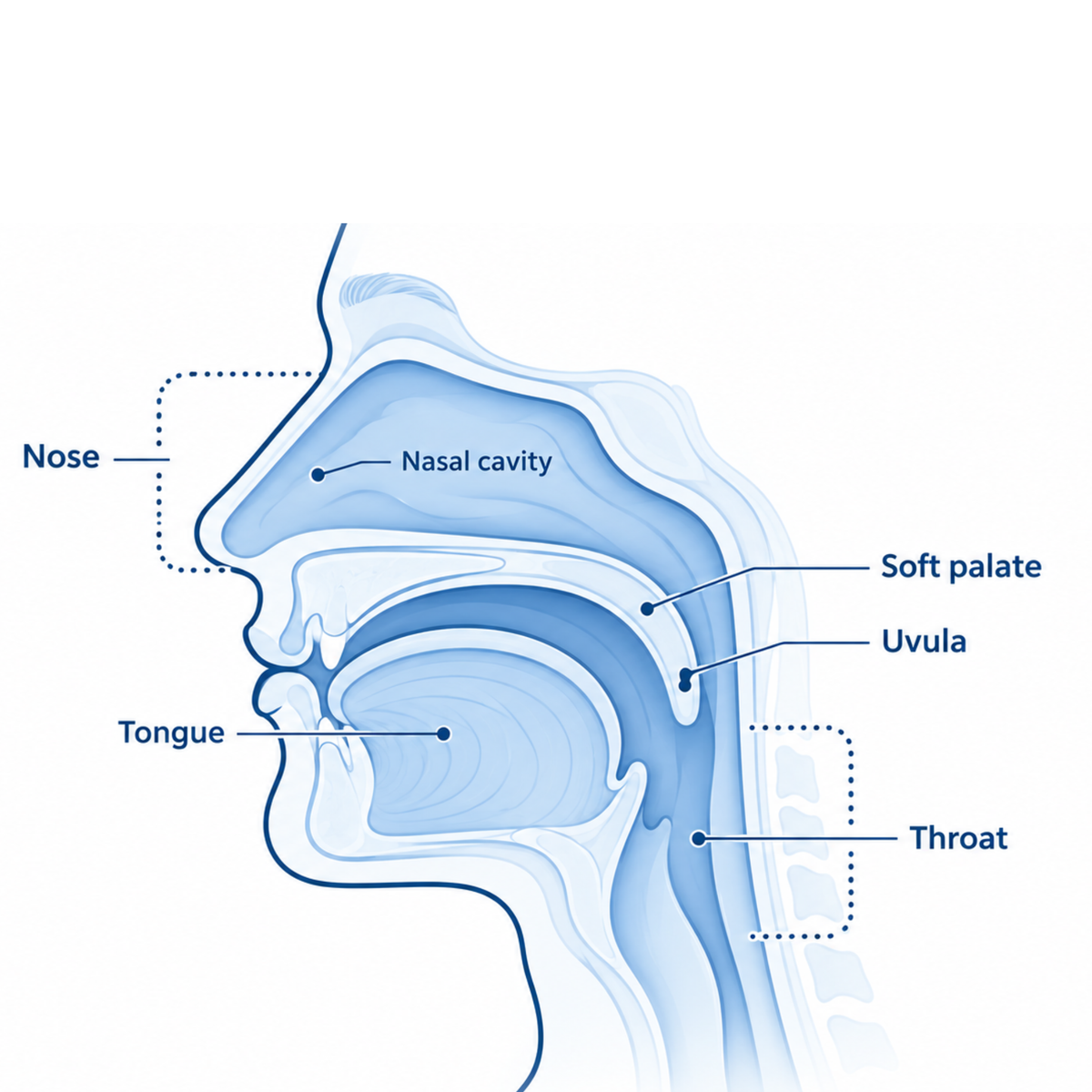
Your nose plays its own role in this. Nasal breathing naturally slows down your breathing pace, humidifies and filters the air, and supports a lower, more efficient breath than mouth breathing. Furthermore, your nose produces nitric oxide, a substance produced by the body that slightly widens your blood vessels and can thus support oxygen delivery; with mouth breathing, you skip that route. The background on this can be found on our page on breathing science.
Moment 1: immediately after the workout (the first 10 minutes)
You gain the biggest advantage in the first minutes after your last set or last kilometer. Use this protocol as a standard cooldown:
- Keep moving calmly for two minutes. Walking or cycling gently prevents your heart rate from abruptly "stalling."
- Close your mouth and switch to nasal breathing. If that feels too suffocating immediately after exercise, give yourself a minute and try again. The moment you are comfortably able to breathe through your nose again is a great sign that your system is calming down.
- Extend your exhalation for five minutes: four counts in through your nose, six to eight counts out. Sitting or lying down, eyes closed if necessary. You can find more variations in our breathing exercises to relax within 5 minutes.
- Check your body. Dropping shoulders, a calmer heart rate, saliva returning to a dry mouth: that is the shift you are looking for.
Ten minutes, no equipment needed, and your recovery begins in the locker room instead of hours later on the couch.
Moment 2: the hours after the workout
After the shower, life takes over: work, eating, screens. Two breathing habits keep your system in recovery mode:
- Breathe through your nose during light activity. Walking to the car, climbing stairs, groceries: mouth shut. This keeps your breathing pace low and your system calm. This is the same training as learning to breathe better during the day, but with a sports goal.
- Add a breathing moment to your meal. Three deep nasal breaths before you eat puts your digestion in rest mode; that, too, is recovery. Your body digests and repairs best in that same parasympathetic state.
During these hours, also watch out for the well-known recovery inhibitors: alcohol after exercise may feel deserved, but it actually disrupts the deep sleep your recovery needs. Read about that in alcohol, caffeine, and sleep.

Moment 3: the night, where true recovery happens
The most intense part of recovery happens during your deep sleep: that is when muscle tissue repair peaks and your system recharges for the next workout. And here, your breathing becomes decisive once again, because mouth breathing at night undermines that very deep sleep.
Those who breathe through their mouths at night sleep more restlessly, dehydrate (dry mouth, waking up thirsty), and snore more—all at the expense of sleep quality. For an athlete, this means: training like a pro, recovering like an amateur.
This is how you turn your night into a recovery machine:
- Train your nasal breathing during the day (see moment 2); your nighttime pattern follows your daytime pattern.
- If your nose is the weak link (narrow, easily blocked after exercise), a nasal strip can mechanically open your nostrils, drug-free. Many athletes now use it at night; read why in why so many athletes use a nasal strip.
- If your mouth drops open at night while your nose is clear, mouth tape gently keeps your lips closed so you automatically keep breathing through your nose. Use it only when your nose is clear and build up usage gradually.
- Protect your sleep duration. Seven to nine hours is not a luxury for athletes, but a part of training. How movement and sleep reinforce each other, read in the influence of exercise on sleep and recovery.

Measure your recovery: three signals without gadgets
You do not need a sports watch to know if your recovery is on track. Three simple signals tell you enough every morning.
1. How you wake up. Do you wake up feeling reasonably fresh the day after a heavy workout, or does your body still feel at 7:00 AM as if the training was an hour ago? Consistently waking up feeling heavy after normal workouts is a sign that your recovery is lagging: in that case, look at your sleep and evening behavior first.
2. Your morning mouth. A dry mouth upon waking betrays nighttime mouth breathing, and with it, lighter sleep than you might think. For an athlete, this is perhaps the most underestimated recovery signal: it tells you that your nights are yielding less than your training hours deserve.
3. The nose test after exercise. After your cooldown, pay attention to how quickly nasal breathing feels comfortable again. If it happens within minutes, your system switches smoothly; if your mouth remains "needed" for a long time, the session was heavy or your system is still restless. You unknowingly build a feel for what a workout actually demands of you.
Note these three signals briefly on your phone for a week and you will have a free recovery monitor that is more honest than many a watch.
And on rest days? Rest does not mean inactivity. A calm walk with nasal breathing, some mobility work, and your regular breathing moments keep circulation and recovery mode active. Those who fill their rest day with stress and screens rest less than they think; those who fill it with calm movement and calm breathing arrive stronger at the start of the next workout.
"Training away muscle soreness is the best recovery"—is that true?
This gym myth deserves nuance. Light movement when experiencing muscle soreness (walking, light cycling, mobility) supports blood flow and can feel pleasant. But "just training hard again" on tired, painful muscles stacks stress onto incomplete recovery; this way, you train yourself *into* fatigue instead of out of it.
The same applies to the idea that recovery equals sitting passively on the couch. Recovery is an active process that you can manage: calm movement, nutrition, sleep—and thus your breathing. Athletes who recover the fastest do not do "nothing"; they consciously do the right, calm things.
For whom is it different?
- Fanatical beginners: if you notice you remain tired, irritable, and sleep poorly for weeks despite all your recovery work, you may be training structurally too much for your current level. No breathing technique repairs a training volume that is too high.
- Nasal issues: if you have a structurally blocked or deviated nose, nasal breathing is not a matter of willpower. Get the cause assessed before you frustrate yourself.
- Endurance athletes with high volumes often benefit from more than just breath work; see breathing as one pillar of recovery alongside sleep, nutrition, and periodization, not as a replacement for them.
When should you see a GP?
Contact your GP if:
- fatigue persists for weeks despite rest and normal sleep;
- your heart rate remains notably high for a long time after exercise or you experience heart palpitations;
- you wake up gasping for air at night or your partner notices breath stops; do not use mouth tape before your GP has checked this;
- you are short of breath at rest or have chest pain during exercise; always take this seriously.
Conclusion
Recovering faster after sports begins with switching, and your breathing is the switch. End every workout with five to ten minutes of calm nasal breathing with extended exhalations, keep your breathing pace low for the rest of the day with nasal breathing during light activity, and protect your night: that is where the real recovery work happens. Nasal strips and mouth tape can support that nocturnal nasal breathing, provided the cause is appropriate. And remember: breath work accelerates recovery, but does not replace sleep, nutrition, and rest days.
Curious where your nocturnal recovery is stalling? Take the sleep test and discover in 30 seconds which approach fits you.
What are you doing now in the first ten minutes after your workout, and what would you do differently after reading this article?

Deel:
Best earplugs for sleeping (2026): how to choose the right ones
Headache caused by mouth breathing: causes & solutions