



You’ve had a busy week, and you’ve felt a nagging ache behind your eyes for days. Stress-related headaches often feel like a tight band around your head, on both sides at once. Most articles stop there: stress causes muscle tension, and muscle tension causes headaches. That’s true, but it’s only half the story. There is a second route: your nights. In this article, you will learn how both routes work, how to recognize which one is affecting you, and what helps for each. You’ll also read an honest account of what a sleep aid won’t do for you.
What exactly is a stress headache?
In most cases, a stress headache is a tension headache: a pressing, tightening pain on both sides of your head that lasts from half an hour to several days. The pain does not worsen with physical activity and is usually not accompanied by nausea.
That last point is the practical difference from a migraine. Migraine pain throbs, is more often one-sided, and is frequently accompanied by nausea and sensitivity to light and sound. Movement typically makes migraines worse, whereas tension headaches can usually be resolved with a walk.
According to Thuisarts.nl, tension headaches are unpleasant but not dangerous, and the exact cause is unknown. Several factors likely work in tandem: tense neck and shoulder muscles, stress, and overusing painkillers. The latter is important; using painkillers more than two days a week can trigger headaches itself.
Read more about the distinction in our article on what really works against migraines and on Thuisarts.nl about tension headaches.
The daytime route: how tension locks your muscles
The most well-known route is via your muscles. When you are tense, you unconsciously clench your jaw, neck, and shoulders. You sit closer to your screen. You breathe shallower and more rapidly. You maintain that posture for hours without noticing it.
Tense neck and shoulder muscles radiate pain to your temples and the back of your head. That is exactly where most people feel the band of pressure. The longer the tension lasts, the more frequently the headache returns.
Your breathing exacerbates this. Under stress, you breathe higher in your chest and faster than necessary. Your auxiliary respiratory muscles in your neck and shoulders then perform work that your diaphragm is supposed to do. These muscles become overloaded. In our article on the difference between the sympathetic and parasympathetic nervous system, you can read how that switch works.
The nighttime route: why your headache is already there in the morning
Do you regularly wake up with a headache? Then the nighttime route is involved. Stress changes not only your muscles during the day but also what your body does at night.
Three things happen at once:
- Lighter sleep. With increased stress levels, you wake up briefly more often without remembering it. Your body doesn't reach as deep a state, and your muscles don't relax as much.
- More jaw and neck tension. In lighter sleep, some people clench or grind their teeth. The chewing muscles radiate pain to the temples. You can read more about this in our article on bruxism and teeth grinding.
- Faster breathing. When you are tense, your respiratory rate is higher at night. You are more likely to breathe through your mouth, which causes dehydration. Even mild dehydration can cause a dull headache in sensitive people.
This combination explains why headaches after sleep often feel worse than those that arise in the afternoon. You are then not rested, stiff, and slightly dehydrated.
Two morning signals tell you which route is involved. A dry mouth and a sensitive jaw point to the nighttime route. Pain that builds up during the afternoon points to the daytime route. Many people experience both.

What helps against stress-related headaches?
There is no single measure that works for all forms of stress-related headaches. This is because the daytime and nighttime routes have different points of intervention. Anyone who relaxes their muscles while the complaints stem from a restless night will see little effect, and vice versa.
The approach therefore follows the route. In the table below, you will find what is logical to try first based on your specific symptoms.
|
What you notice |
Likely route |
Where to start |
|
Pain builds up during the day |
Daytime route, muscle tension |
Micro-breaks, relax shoulders, lower breathing rate |
|
Waking up with headache and dry mouth |
Nighttime route, mouth breathing |
Support nasal breathing, water by your bed |
|
Waking up with a stiff or sensitive jaw |
Nighttime route, jaw tension |
Jaw relaxation before bed, consult dentist |
|
Pain in light and noisy bedroom |
Nighttime route, disturbed sleep |
Darken and soundproof sleeping environment |
|
Pain almost every day, for weeks |
Mixed or medication-related |
General practitioner, discuss painkiller usage |
During the day. Every hour, lower your shoulders and unclench your jaw for thirty seconds. Let your tongue rest against the roof of your mouth, with your teeth just apart. That is the neutral jaw position.
In the evening. Actively lower your breathing rate. Exhaling more slowly than inhaling puts your nervous system in a relaxed state. Our article on paced breathing contains a rhythm you can try immediately. A consistent habit works better in the long run than an occasional exercise.
At night. This is where your sleep environment can make a difference. Light that makes your sleep shallower keeps your muscles tense. A well-fitting sleep mask removes that stimulus without pressing on your eyes. If you sleep with headache or migraine complaints, the migraine mask provides gentle cooling or warmth.
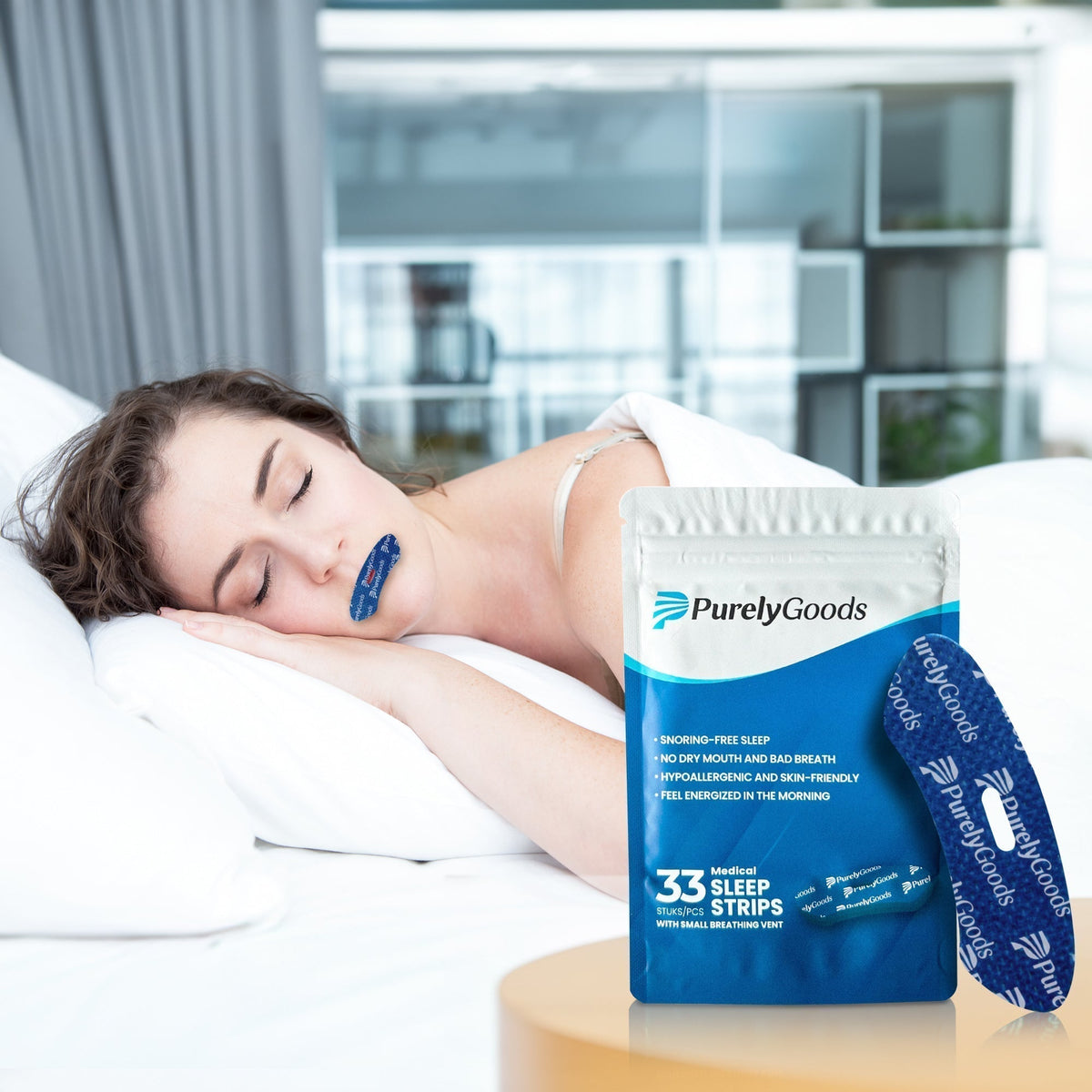
If you wake up with a headache and a dry mouth, nasal breathing is the first starting point. Nose strips keep your nostrils open if they tend to collapse. If your nose works well and your mouth just falls open, mouth tape is an option.
How to find your trigger in two weeks
Guessing works poorly with headaches, because there are almost always several factors at play simultaneously. Measuring for two weeks yields more than two months of trying.
Keep a simple headache diary with five columns. Note the following every day:
- Time the pain started, and where it was located.
- Sleep: what time you went to bed, and how often you woke up.
- Morning signals: dry mouth yes or no, stiff jaw yes or no.
- Tension on a scale of 1 to 5.
- Painkillers: which remedy and how much.
After fourteen days, look for correlations. If the pain almost always starts after 2:00 PM on busy days, the daytime route is leading. If your headache days consistently note a dry mouth or a stiff jaw, the nighttime route is leading. If you see no pattern other than painkiller usage, medication-overuse headache is a real possibility.
This diary is exactly what your GP will ask for if you visit with recurring headaches. You will save yourself a consultation that ends with "come back in two weeks with some notes."
One warning about measuring: keep it light. Scoring your sleep in detail every day can actually increase tension. Two weeks, five columns, and then stop.
What works less well than you think
There is advice circulating about stress-related headaches that sounds logical but is disappointing in practice. Some of these actually sustain the complaints. Below are three assumptions that deserve nuance, along with what is actually correct.
"A painkiller will solve it." A painkiller takes away today’s pain, not the tension causing it. Frequent use leads to medication-overuse headaches, where the painkiller itself sustains the headache. Thuisarts.nl explicitly mentions this as a pitfall.
"I just need to go to bed earlier." Lying in bed longer with a tense body does not lead to deeper sleep. It is about the state you are in when you lie down, not the duration. Relax first, then go to bed.
"A sleep mask or mouth tape will take away my headache." They won't. A sleep aid improves a condition: less light, or easier nasal breathing. If the source is stress, stress remains the source. These products are useful as an addition, not as a treatment.
For whom this approach is and isn't suitable
The approach in this article is suitable for recurring, dull headaches associated with busy periods, poor nights of sleep, or a tense jaw.
This approach is NOT suitable for headaches that come on suddenly and severely, headaches accompanied by neurological symptoms, or headaches that feel clearly different from what you are used to. In such cases, do not use a self-help route, but call your GP.
Also, do not use mouth tape if your nose is blocked at night, or if there is a possibility of breathing pauses during your sleep. Consult your GP about this first.
In summary
Stress-related headaches follow two routes. During the day, tension causes your neck, shoulder, and jaw muscles to tighten. At night, tension makes your sleep lighter, your jaw more tense, and your breathing more restless. You can tell which route is involved in your case by the time the pain arises and by other symptoms you notice in the morning. Tackle the appropriate route: breathing pace and micro-breaks for the day route, sleep environment and nasal breathing for the night route. If the headache persists, or if you frequently use painkillers, see your GP.

Deel:
How to sleep better on a plane (using breathing techniques)
Sleepmaxxing: what actually works and what is hype?