



Written by Rüben Spapens
You're in bed. You're tired, but you can't sleep. Your mind keeps going back to that email, this afternoon's conversation, or everything that needs to be done tomorrow. The harder you try to sleep, the more awake you seem to become.
Fortunately, we all have a simple tool to make this a bit easier: breathing.
Your breathing tells you something about the state of your body
Breathing and our physical and mental state constantly influence each other. When you are stressed, exercise intensely, or are startled, your breathing changes. Conversely, changes in your breathing also affect the autonomic nervous system and, consequently, processes such as your heart rate, blood pressure, and digestion.
Your breathing is one of the few processes in your body that largely happens automatically but that you can also consciously influence. And that's where something interesting lies: you can practice using your breathing more and more effectively to move towards relaxation.
Just don't expect to be good at it right away. If you've never consciously worked with your breathing, slower and calmer breathing might initially feel unfamiliar. Especially during moments of high stress.
Therefore, see it as a skill. Just as you get stronger by regularly doing strength training, you can also get better at using your breath to switch off. By regularly practicing, you learn to better recognize what breathing tempo suits you, how much tension you unconsciously hold, and how to slow down your breathing without your body resisting.
Ultimately, you want the path from "on" to "off" to become more and more familiar. Not because a specific breathing technique puts you to sleep, but because you are getting better at creating the physical and mental conditions in which you can relax and sleep deeply.
Why we prefer not to prescribe a fixed breathing rhythm
Online you will find countless breathing exercises for sleeping:
Breathe in for four seconds, hold for seven seconds, and breathe out for eight seconds.
Or:
Breathe exactly six times per minute.
That can work just fine. But not for everyone.
Imagine someone who gets into bed after an extremely stressful day. Their breathing is fast, shallow, and relatively large. Then they suddenly try an exercise where they have to breathe very slowly and hold their breath for a long time. Instead of relaxation, they experience air hunger and even more tension in body and mind to reach that specific number of seconds at all costs.
This is because not everyone has the same mechanical and biochemical conditions to comfortably breathe slowly. That's why we prefer not to work with standard exercises, but instead look for the right breathing tempo for the person in front of us.
First breathe well, then slower
Before going to sleep, we look for what we call flow breathing.
That's not a fixed number of breaths per minute. It's a tempo at which you can currently breathe calmly and comfortably, with a little bit of attention. Exactly the right amount of challenge needed to enter a flow state.
We also look for a number of conditions:
- Breathe through your nose (stimulate with nasal strips)
- Allow the breath to originate low and diaphragmatically.
- Let the lower ribs and abdomen move gently all around.
- Breathe lightly and relaxed, without unnecessarily deep breaths.
- Choose a pace where you don't experience air hunger, tension, or the urge to compensate.
You could summarize it as low, slow and relaxed breathing.
It is important that "slow" is relative.
For one person, six breaths per minute feels wonderful. For someone else, that might be too slow. So you don't have to breathe at a so-called ideal tempo. First, find the tempo at which your breathing can flow effortlessly low and slow.
Exercise: find your flow
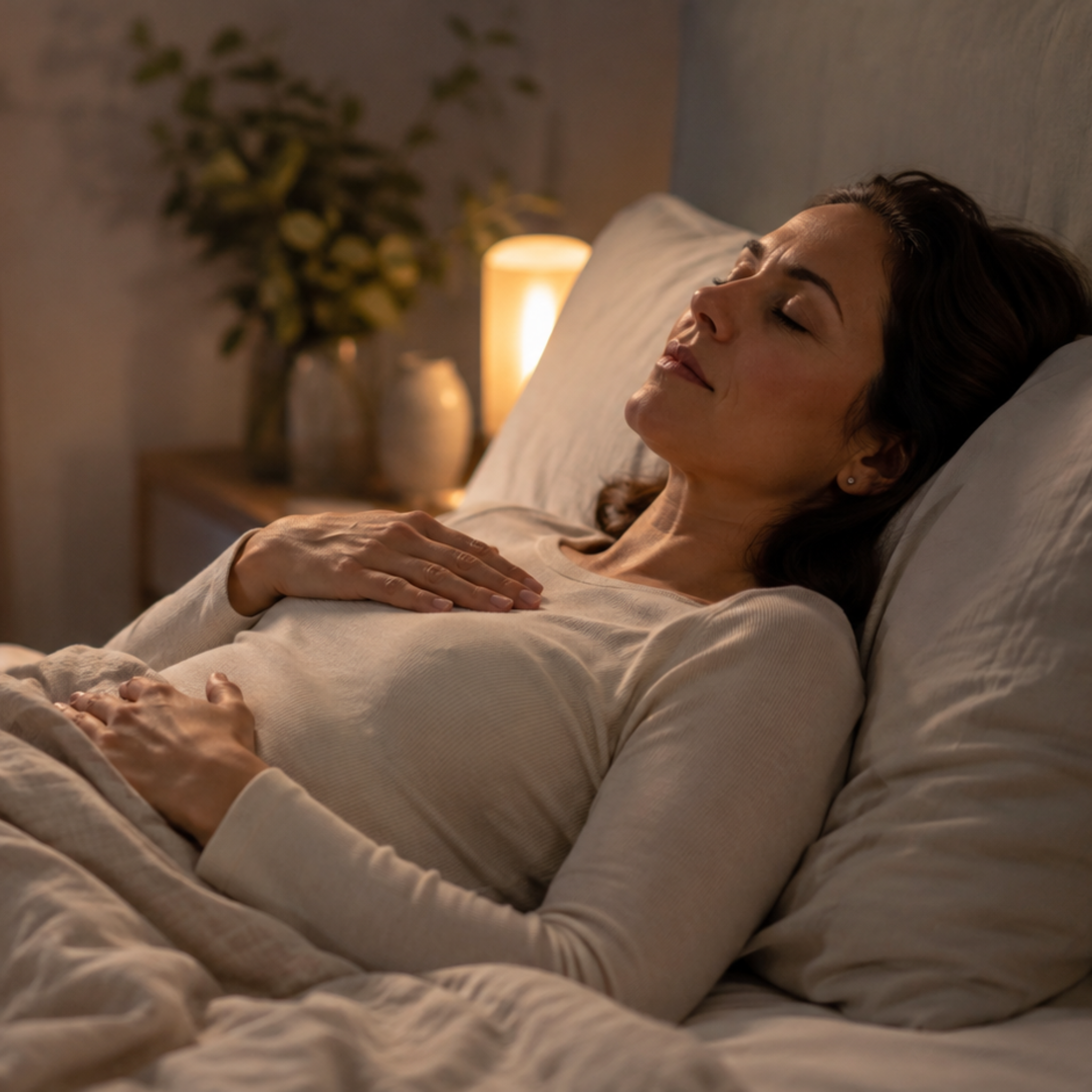
Lie comfortably in bed and, if necessary, place one hand on your chest and one hand around your lower ribs or abdomen.
Breathe calmly through your nose.
Initially, try not to change anything. Just observe what is happening.
Where do you feel the movement? How deep are your breaths? How fast are you breathing? Do you feel tension in your belly, chest, shoulders, neck or face?
Then, allow the breath to originate lower in your torso. Not by pushing your stomach forward excessively, but by letting your diaphragm do its work and allowing your lower ribs and abdomen to move along relaxedly.
Then, make your breathing a little calmer. Not as slow as you possibly can. But as slow as feels relaxed at this moment. That is your starting point. Stay there for a while and then see if you can gradually slow down the pace. Perhaps your exhale will naturally become a little longer. Perhaps a small natural pause will occur before the next inhale begins.
Don't force anything. As soon as you notice that you want to gasp for air, need deeper breaths, are building up tension, or are working very hard to maintain the pace, you have probably gone a step too far and should take a step back. The goal is not to breathe as slowly as possible. The goal is to be able to breathe more and more calmly without losing relaxation.
If you practice this more often, you will likely notice that a tempo that initially felt slow will become more natural over time. You don't have to force your breathing to a specific number. You develop the ability to breathe calmly with less and less effort.
Why 'deep breathing' doesn't always help
You often hear it: take a nice deep breath.
But if 'deep' means you're pulling in extra air, it will have the opposite effect. Your breathing not only functions to get oxygen into your body. With every exhalation, you also get rid of carbon dioxide (CO₂). When you breathe more than your body needs at that moment, you lose more CO₂ than you produce. The amount of CO₂ in your blood decreases. This can contribute to light-headedness, tingling, and feelings of restlessness.
When you are lying in bed, your body's energy demand is low, so deep breathing is not necessary.
Ultimately, let go of the exercise too
You don't have to maintain perfect diaphragmatic breathing for twenty minutes. Use the first few minutes to guide your body and mind towards calm. As soon as you notice your attention beginning to wander, your breathing naturally becoming calmer, or you becoming drowsy, let go of control. Perhaps you lose focus, forget what you were doing, or fall asleep halfway through. In this case, that is exactly the intention. The more often you practice this, the better you will become at it.
Breathing is part of the bigger picture
A breathing exercise can help support the transition to sleep, but good sleep, of course, depends on much more.
Light, regularity, movement, stress, caffeine, temperature, and your sleep environment all play a role. And ultimately, sleep itself remains one of the most important recovery processes.
Would you like to better understand what happens during the different sleep phases and why sleep is so important for recovery? Then read on in the sleep science knowledge base. Do you want to know more about the role of rest and recovery during the day? Then also read the article How deep rest helps the body recover.
About the author
Rüben Spapens is co-founder of Lekker Ademen. From the perspective of respiratory physiology, he helps people to better understand their breathing and use it functionally for more calm, recovery, and physical and mental performance.
Would you like to work on your breathing yourself? At Lekker Ademen, you can find 1-on-1 breathing coaching or experience the power of breathing yourself during one of our workshops and events on Prinseneiland. If you want to delve deeper and learn to professionally apply breathing techniques to others, you can learn all about the physiology, biochemistry, and practical application of breathing in our 24-week Breathing Coach Training.
Deel:
Breathing exercises to relax in 5 minutes
Alcohol, cafeïne & slaap; de echte impact