


Your dentist says you grind your teeth. You don't notice it yourself, except for a stiff jaw and a dull pressure at your temples when you wake up. Almost every article on sleep bruxism points immediately to stress. Stress is a factor, but it is rarely the whole story. For many people, the trigger lies in the sleep itself: in how often you briefly wake up and in how you breathe. This article explains those three nightly routes and which approach makes sense for each.
How to recognize nocturnal grinding and clenching
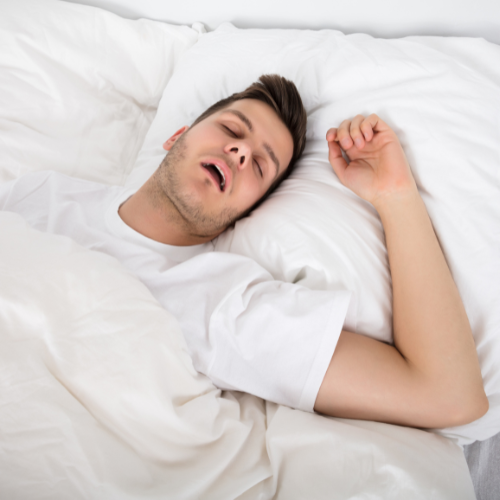
You don't notice the grinding yourself because it happens while you are asleep. You notice the consequences if:
- Your jaw feels stiff or tired in the morning, and it loosens up over the course of the day.
- You have a dull pressure at your temples or behind your eyes upon waking.
- Your teeth feel sensitive to hot or cold for no apparent reason.
- Your partner hears a cracking or grinding sound at night.
- Your dentist sees flat, shiny spots on your molars.
- You have earaches or tinnitus without an ear infection.
- You regularly have neck or shoulder complaints after sleeping.
Three or more of these points make sleep bruxism likely.
What is sleep bruxism?
Sleep bruxism is the unconscious grinding or clenching of teeth and molars during sleep. Daytime bruxism is different: it is primarily clenching, and you usually notice it.
This distinction is practically relevant. Trying to consciously release your jaw during the day doesn't work at night because you aren't present. That is why the nightly variant requires a different approach: not adjusting your behavior, but the circumstances in which you sleep.
Three ways poor sleep fuels grinding
Your chewing muscles do nothing on their own at night. They react to what else is happening in your sleep. That is why it is more productive to look at your night as a whole rather than just your jaw.
Three mechanisms consistently recur: how often your sleep becomes light, how smoothly you breathe, and what you consume in the hours before bed. They are described separately below, but in practice, they often reinforce each other.
Route 1 - Light sleep with many short awakenings
During the night, your body briefly shifts into a lighter sleep stage dozens of times. This is normal. Around such a transition, muscle activity briefly increases, including in your jaw muscles. The more frequent and intense those transitions, the more opportunity there is to clench.
Everything that makes your sleep shallower increases the number of opportunities. Think of light coming through your curtains, noise, a room that is too warm, or an irregular rhythm. In our article on sleeping through the night, you can read how these interruptions arise.
Route 2 - Breathing that is under pressure at night
When your nose is blocked or your airway narrows, your body must work to get air in. That exertion makes your sleep lighter. For some people, the lower jaw then moves forward or the chewing muscles tense up.
Snoring and grinding therefore occur together more often than coincidence explains. This makes the direction of cause and effect tricky: grinding can be a reaction to breathing that is not smooth, rather than a separate problem.
Route 3 - Substances that disrupt your sleep depth
Alcohol, nicotine, and caffeine all shift your sleep structure to a lighter state. Alcohol relaxes your muscles at the beginning of the night but disrupts the second half. Caffeine remains active for hours. Nicotine is a stimulant.
This is arguably the most underestimated factor. A drink in the evening feels relaxing but causes exactly the restless second half of the night in which clenching increases.

Stress is not always the cause, and that changes your approach
This is where the difference lies compared to most articles on this topic. They end with two pieces of advice: reduce stress and get a mouthguard.
Reducing stress is useful, and a mouthguard protects your teeth from wear. But a mouthguard does not stop the grinding; it cushions it. And if your grinding is primarily related to a restless night or sleep-disordered breathing, stress reduction alone will be ineffective. You would be addressing the wrong factor.
Practical test: keep track for two weeks of which nights your jaw feels stiff in the morning, and note three things: how much alcohol you drank, how blocked your nose was, and how often you woke up. If you see a pattern with alcohol or a blocked nose, that is where the approach lies. If you only see the pattern in busy weeks, then stress is indeed the main factor.
Daytime jaw tension carries over to the night
Sleep bruxism and daytime bruxism are often treated separately, but they reinforce each other. Anyone who keeps their teeth clenched for hours during the day starts the night with chewing muscles that are already fatigued.
Test it right now. Where are your teeth at this moment? Are your upper and lower teeth touching? At rest, there should be space between them, with your lips closed and your tongue resting loosely against your palate. This position is called the resting position of the jaw.
Many people discover during this test that they clench without knowing it. Typical moments: during screen work, in traffic, and during physical exertion like lifting or sports.
Three habits unnecessarily strain your chewing muscles during the day:
- Chewing gum for long periods.
- Nail biting or chewing on a pen.
- Clamping your phone between your shoulder and ear during calls.
Every time you correct yourself during the day, you lower the base tension you take to bed in the evening. This is not a spectacular intervention, but it is one you can control, unlike everything that happens at night.
What helps with jaw tension caused by poor sleep?
The order is more important here than the number of measures. Start with the route that best fits your situation, give it two weeks, and only then add something else. Trying to tackle everything at once makes it impossible to see what works.
The table below links your morning signal to the first step that goes with it.
|
What you notice |
Route |
First step |
|
Stiff jaw after an evening of alcohol |
Substances |
Stop alcohol at least 3 hours before bedtime |
|
Stiff jaw plus dry mouth and blocked nose |
Breathing |
Improve nasal patency |
|
Stiff jaw after nights with frequent waking |
Light sleep |
Address light and noise in the bedroom |
|
Stiff jaw primarily during busy work weeks |
Tension |
Jaw relaxation and breathing pace in the evening |
|
Visible wear or pain in the jaw joint |
Damage |
Consult dentist about a mouthguard |
Relax your chewing muscles before sleep. Keep your teeth apart, with your tongue relaxed against your palate. Slowly open and close your mouth a few times. Massaging your chewing muscles, just in front of your ears, makes the difference tangible.
Lower your breathing rate. Exhaling longer than you inhale lowers muscle tension throughout your entire body, including your jaw.
Make your sleep less shallow. A dark, cool, and quiet room reduces the number of short awakenings. A well-fitting sleep mask or earplugs can help when your environment cannot be fully adjusted.
Support your nasal breathing if your nose is often blocked. If your nostrils collapse easily, nasal strips gently pull the nostrils apart from the outside. You can read how that works in how nasal strips work.
Why mouth tape is not a remedy for teeth grinding
Mouth tape and snoring mouthpieces often appear in search results for teeth grinding because both involve the mouth and jaw. That association is understandable, but it is incorrect. A tool only works if it targets the mechanism causing your complaint.
Therefore, you should know this before you buy anything: mouth tape is not a solution for teeth grinding.
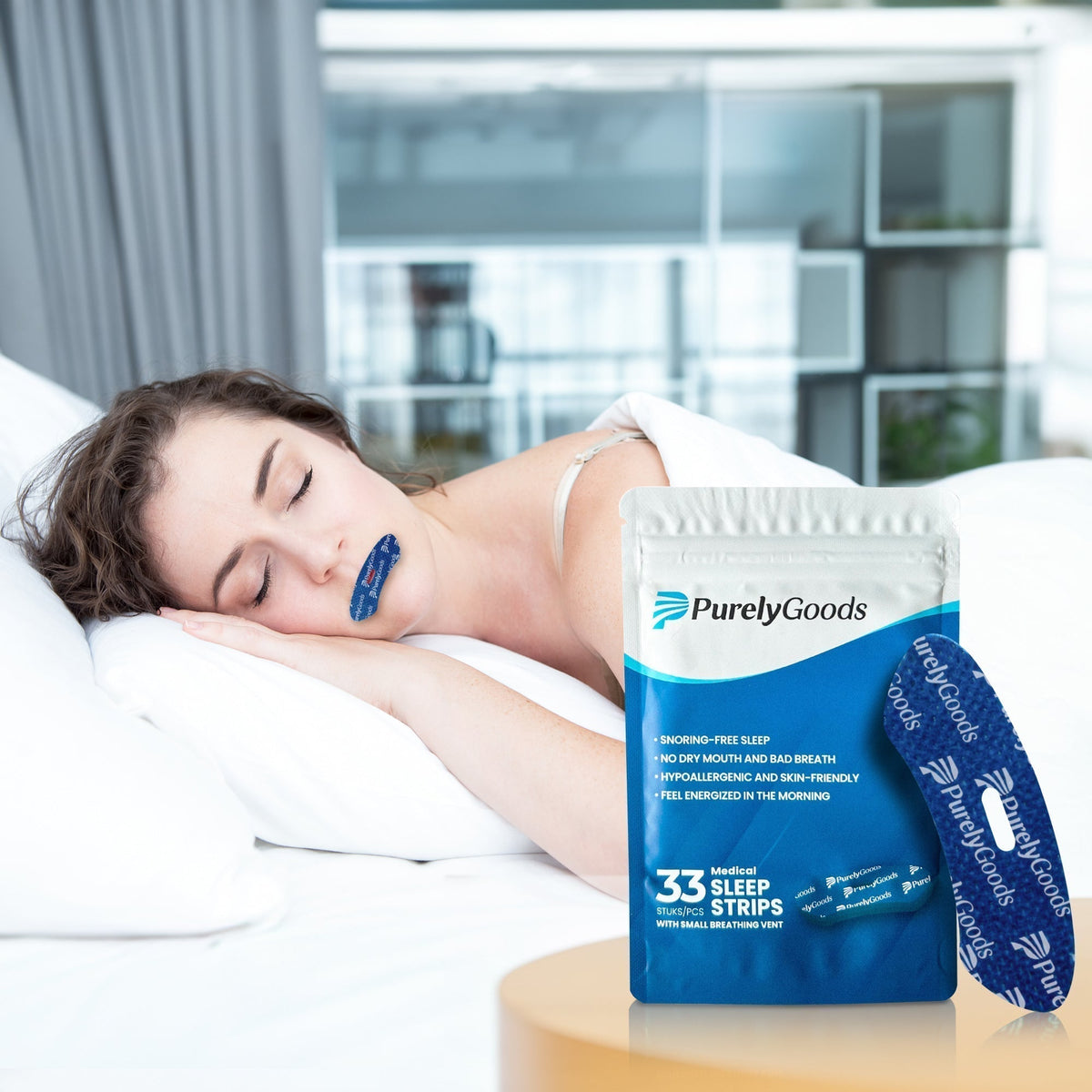
Mouth tape keeps your lips closed so that nasal breathing is encouraged. It does nothing for the force with which your jaw muscles contract. In fact, for people who clench at night, a closed mouth can leave the clenching unchanged, even though the expectation has been raised.
Mouth tape is logical when grinding occurs in conjunction with mouth breathing and a dry mouth, and your nose is otherwise clear. In that case, you are addressing the breathing route, not the grinding itself. Always read when mouth tape is not advisable beforehand.
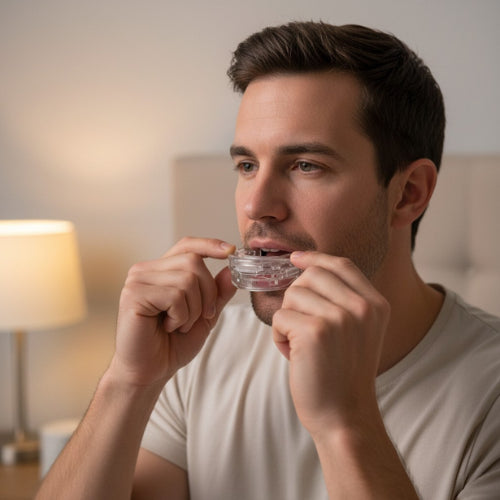
An anti-snoring mouthpiece is also not a night guard. A snoring mouthpiece keeps your lower jaw forward to widen your airway. A night guard protects your teeth from grinding forces. These are different purposes and different aids. If you want to know which anti-snoring aid fits which cause, please use our anti-snoring aid comparator.
In summary
Jaw tension and teeth grinding during sleep are rarely caused by a single factor. In addition to stress, three nocturnal routes play a role: lighter sleep with many short awakenings, breathing that is under pressure, and substances that disrupt your sleep depth. You can discover which route applies to you by linking your morning jaw state to alcohol consumption, nasal congestion, and nocturnal awakenings for two weeks. Only then should you choose an approach that makes sense. A mouthguard protects your teeth but does not replace that investigation. In case of pain in the jaw joint or suspicion of breathing pauses, consult your dentist or general practitioner.
Deel:
Sleepmaxxing: what actually works and what is hype?
Silk vs. cotton sleep masks: which is better for skin and sleep?