


How much light does a sleep mask through?
We measured our cotton and silk sleep masks with a lux meter to determine how effective they are at blocking light. You can see how much light passes through the fabric and how much light three test subjects could see around their noses. Internal results from November 21, 2026.
What the lux meter let see
We tested our cotton and silk sleep mask with a digital lux meter. First, we measured how much light falls on the sensor without the mask. Then we placed the mask over the sensor and took another reading.
| Measurement | Read light value | Fit for 3 test subjects |
|---|---|---|
| Without mask (reference) | 1,025 lux | Not applicable |
| Sensor fully covered | 0.00 to 0.01 lux (fluctuates) | Not applicable |
| PurelyGoods cotton sleep mask | 0.01 lux | No visible light (3 out of 3 test subjects, score 0) |
| PurelyGoods silk sleep mask | 0.01 lux | Slight leakage around the nose (3 out of 3 test subjects, score 1) |
How to interpret the figures. A reading of 0.01 lux is at the detection limit of the lux meter. A completely covered sensor measured 0.00 to 0.01 lux in our tests. Our meter therefore cannot show whether a very small amount of light still gets through the dust. The cotton and silk show no difference in this test.
Light along the edge
Light comes not only through the fabric, but also around the edges of a mask. Therefore, we had three test subjects put on the masks and assessed the light at the nose on a scale of 0 to 3 (0 = no light, 1 = slight leakage, 2 = clearly visible, 3 = significant leakage).
With the cotton mask, none of the three test subjects saw any light. With the silk mask, all three saw slight leakage at the nose. With three people, this is an observation, not a result applicable to everyone: face shape and the way it is worn make a difference.
This is how we have measured
- Meetapparaat
- Extech LT300 Digital Lux Meter
- Lichtbron
- LED lamp, approximately 2 meters from the sensor
- Referentie zonder masker
- 1,025 lux
- Opstelling
- Mask placed over the sensor
- Meetpunten
- Left eye, right eye and thinnest part of the mask
- Herhalingen
- 3 per measuring point, mask repositioned each time
- Pasvormtest
- 3 test subjects, score 0 to 3 for light along the edge
- Testdatum
- 11-21-2026
-
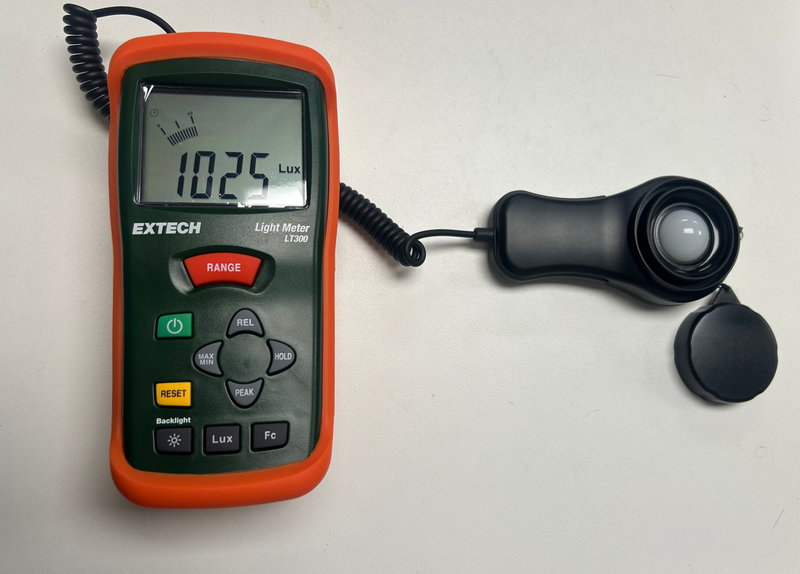
Baseline measurement without mask: 1,025 lux -
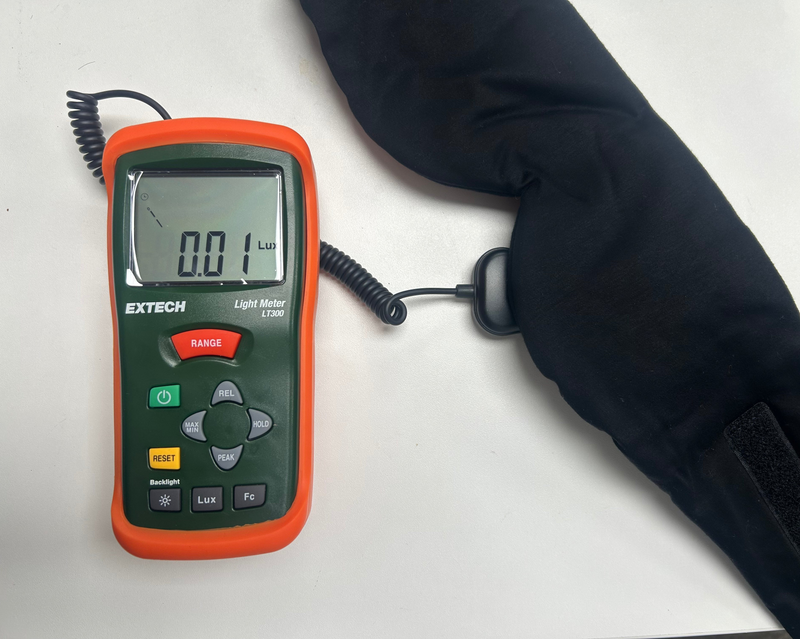
Cotton mask for the sensor -
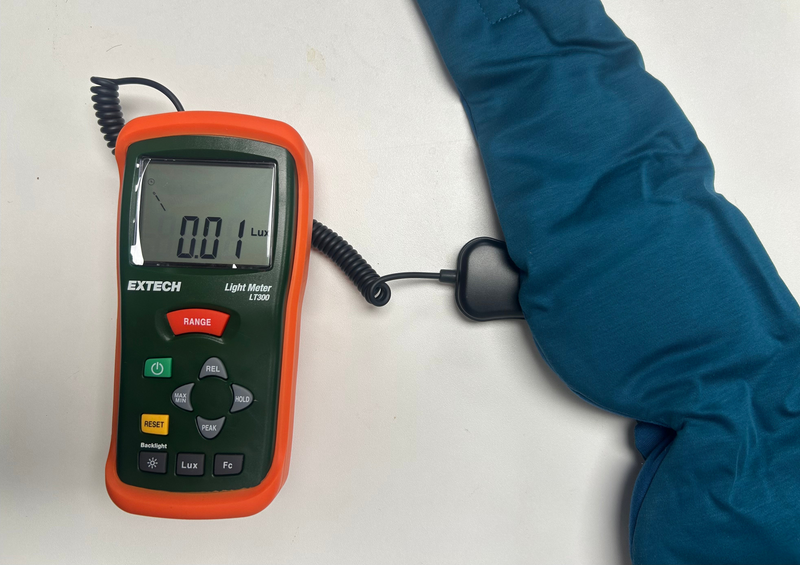
Cotton mask, second measurement point -
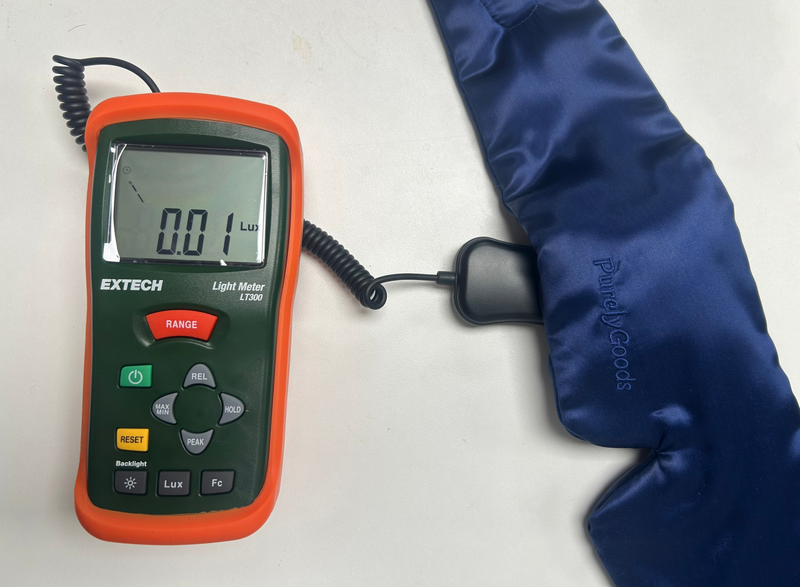
Silk mask for the sensor
What this test is and is not. This is an internal test using one meter, one lamp, and one setup. It is not a certified laboratory study. The test provides information about the light behind the material and around the edges of the mask, and nothing about sleep quality or health.
More about blackout sleep masks
Are you torn between cotton and silk? Read silk versus cotton sleep masks or use our guide to choose the best sleep mask. Learn more about Lux as a company in Why is daylight important?
Download the measurement data
The raw readings per measurement point and repetition, with an explanation of the method.
Frequently asked questions
Didn't find what you were looking for? Feel free to contact us.
How did you measure the light?
We held the mask material over the sensor of an Extech LT300 lux meter, with an LED lamp at approximately 2 meters. Without the mask, the meter read 1,025 lux. The complete setup is described in the "How we measured" section.
What does 0.01 lux mean in this test?
Lux is the unit for illuminance. Behind both masks, our meter measured 0.01 lux, the smallest increment it can display. You can read more about lux as a unit in Why is daylight important?
Is a blackout sleep mask really dark?
In our test, the lux meter measured 0.01 lux behind the cotton and silk mask. Without the mask, it was 1,025 lux. That is at the measuring limit of the meter, which is why we do not state a percentage. In reality, it also depends on how the mask fits, because light also gets in around the edges.
Why doesn't it say 0.00 lux?
With a completely covered sensor, our meter fluctuates between 0.00 and 0.01 lux. A reading of 0.01 lux is therefore at the limit of detection. Our meter cannot show whether a very small amount of light still gets through.
Is this a certified or independent test?
No. It is an internal test with one meter, one lamp and one setup. We will publish it with the method and photos, so you can see how we measure.
What did the test subjects say about the fit?
Three test subjects rated the light around the nose on a scale of 0 to 3. No one saw light with the cotton mask, while all three saw a slight leak with the silk mask. If a mask does not fit properly, read about a sleep mask that does not shift.
Can I use or share the results?
Yes, please, with attribution and a link to this page. Once the repeat measurements are ready, you can download the measurement data as a CSV.